
Fall Arrest Lanyards: Types & Lengths Explained
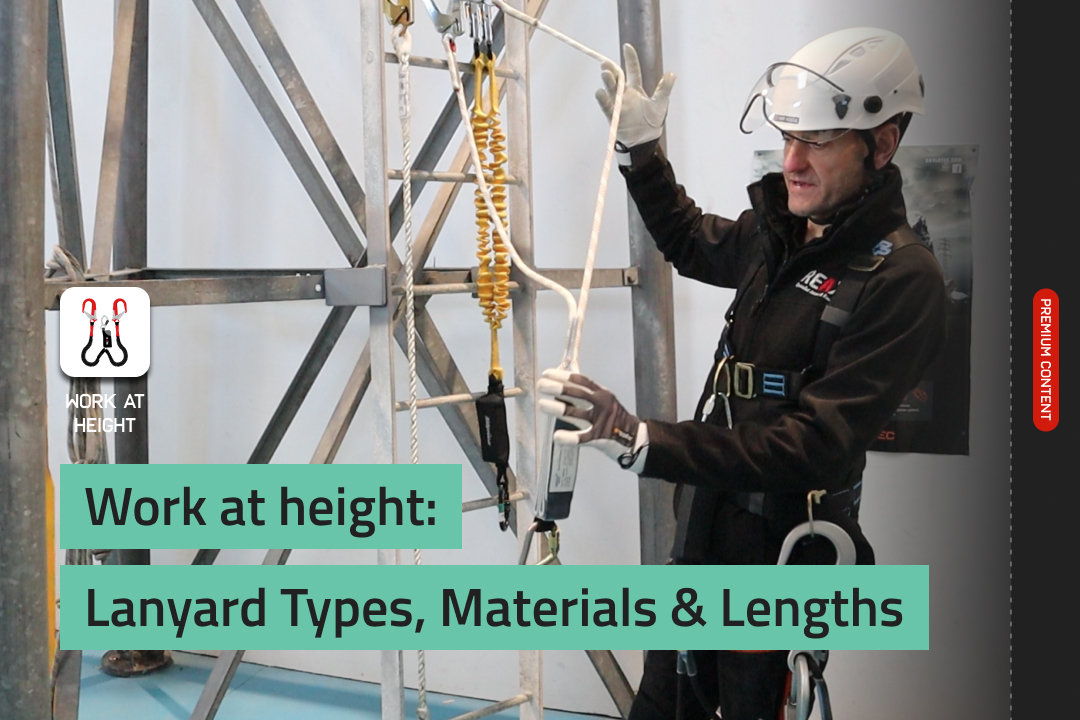

Fall arrest lanyards come in many types, lengths and materials and understanding these differences is essential for controlling fall distance and reducing risk. We unpack the basics behind lanyard construction, energy absorbers and fall factor, helping you make safer choices when working at height.
🎥 Watch the full video:
Not all lanyards behave the same when they deploy. Factors such as material, total extended length and whether the legs are elasticated or fixed all influence your total fall distance.
A key principle is understanding fall factor:
- Fall factor 0 — anchor point above you; safest scenario.
- Fall factor 1 — lateral movement with moderate fall distance.
- Fall factor 2 — worst case; anchor point at foot level, creating a fall of up to twice the lanyard length before the stop.
This is why correct anchor points and suitable lanyard selection are critical. Choosing the wrong setup can easily create a fall of four metres or more before the energy absorber even begins to deploy.
Practical Steps / Key Takeaways
Know your lanyard length:
Elasticated legs extend further than many people expect, increasing fall distance.
Understand material differences:
Rope, webbing and elasticated options behave differently during movement and deployment.
Avoid mixing components incorrectly:
Two single-leg lanyards do not equal a twin-leg system. Dual shock absorbers require far more force to deploy.
Use high, strong anchor points:
High attachment = reduced fall factor and shorter total fall distance.
Choose the right configuration for the task:
Single lanyards for static connection; twin lanyards for continuous attachment while moving.
Always check the energy absorber:
This is the critical component that reduces impact force without it, the system cannot protect you.
We regularly see teams using lanyards that aren’t suited to their work positioning or the environment they’re operating in. Small decisions such as anchor height, lanyard type or material can add metres to a fall and significantly increase risk.
Our training focuses on understanding how equipment behaves in real-world conditions. We help teams assess fall distance, choose appropriate systems and avoid common setup errors that compromise safety at height.
Need support choosing the right height safety equipment?
Contact our equipment team today for sales enquiries, expert guidance, practical demonstrations, and affiliated training courses:
📞 - 01253 767775 Opt 2


Looking after your kit
Even the best kit needs regular inspection and servicing. we have a team of fully trained PPE inspectors who can take the worry out of the process. Our servicing team are fully certified to carry out the servicing requirements for many of the leading rescue devices currently on the market.



Unit 4 Keystone Court, Hallam Way,
Whitehills Business Park,
Blackpool,
FY4 5NZ
Company Number: 09204984
VAT No: 199729531
01253767775 Opt 1
info@reaxltd.com
Unit 1 & 2 Keystone Court, Hallam Way,
Whitehills Business Park,
Blackpool,
FY4 5NZ
Company Number: 11576372
VAT No: 307530624
01253767775 Opt 2
equipment@reaxltd.com