
What Is a Confined Space? Safety Explained
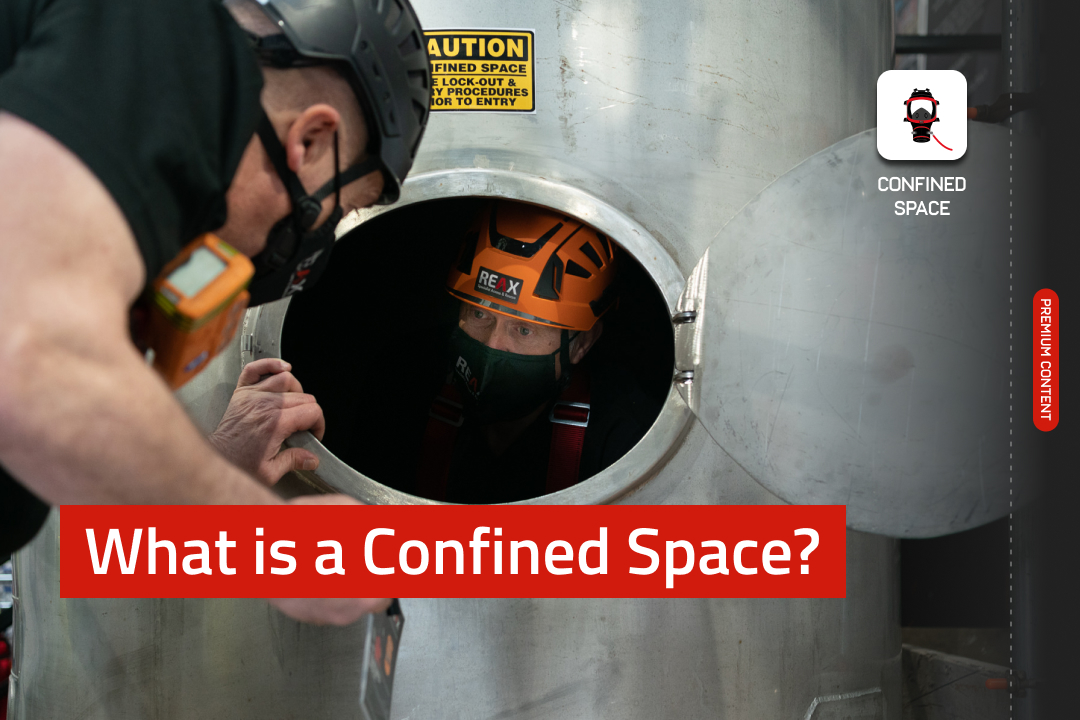
What Is a Confined Space? Safety Explained
When people hear the term “confined space,” they often picture a tight, enclosed area with limited access. While that can be true, it’s only part of the definition.
A confined space isn’t just about size or access, it’s about risk.
Understanding what truly defines a confined space is critical for planning, compliance, and keeping teams safe on site.
Watch the full video:
A confined space is any area that is fully or partially enclosed and presents a risk of serious injury or harm.
This means spaces such as:
- Tanks
- Silos
- Trenches
- Pits
- Wells
Can all be classified as confined spaces even if they appear open or accessible.
What actually defines the space is the presence (or potential) of specific hazards.
There are five key risks to consider:
- Fire & explosion – Flammable atmospheres
- Heat – Risk of heat stress or loss of consciousness
- Entrapment – Free-flowing solids or restricted movement
- Asphyxiation – Toxic gases or lack of oxygen
- Drowning – Rising liquids
If any one of these risks is present or foreseeable, the space must be treated as a confined space.
Practical Steps / Key Takeaways
- A confined space doesn’t have to be fully enclosed
- Always assess for specified risks, not just physical size
- Use a structured risk assessment before entry
- Implement control measures to eliminate or reduce risk
- Classify the space (low, medium, high risk) based on hazards
- Ensure rescue plans and emergency procedures are in place
- Never assume a space is safe without proper assessment
One of the most common issues we see on site is misidentification.
Teams often assume:
- “It’s open, so it’s safe”
- “We’ve been in there before without issues”
But confined space incidents rarely come from the obvious risks, they come from the unseen or underestimated ones.
Gas build-up, changing environmental conditions, or simple oversights can quickly turn a routine task into a high-risk situation.
That’s why confined space safety isn’t just about access. It’s about understanding the environment, identifying hazards early, and putting the right controls in place every time.
Understanding the NC System
Alongside identifying confined spaces through risk, many industries also use the NC (National Classification) system to help define how those spaces should be approached.
The NC system categorises confined spaces into levels such as NC1 through to NC4 and NCX, aligning broadly with low, medium, and high-risk environments. Each level introduces increasing requirements for control measures, equipment, and rescue planning.
This provides a more structured, practical framework for teams on site. Helping bridge the gap between theory (risk assessment) and real-world application.
If you’re working in utilities, water, or infrastructure sectors, understanding how the NC system applies to your work is essential for safe entry and compliance.
Learn more about the NC system here ↗︎
Need help with your confined space safety?
Safety Consultancy & Rescue ↗︎


Looking after your kit
Even the best kit needs regular inspection and servicing. we have a team of fully trained PPE inspectors who can take the worry out of the process. Our servicing team are fully certified to carry out the servicing requirements for many of the leading rescue devices currently on the market.


Unit 4 Keystone Court, Hallam Way,
Whitehills Business Park,
Blackpool,
FY4 5NZ
Company Number: 09204984
VAT No: 199729531
01253767775 Opt 1
info@reaxltd.com
Unit 1 & 2 Keystone Court, Hallam Way,
Whitehills Business Park,
Blackpool,
FY4 5NZ
Company Number: 11576372
VAT No: 307530624
01253767775 Opt 2
equipment@reaxltd.com