
Skills Fade in Confined Space Training
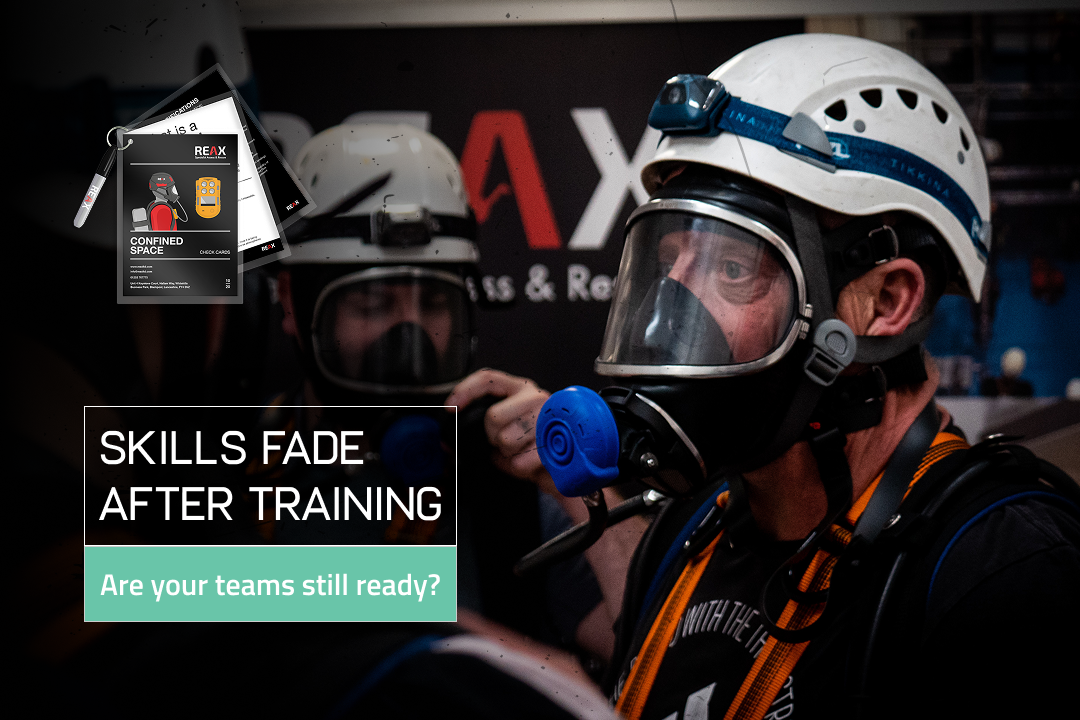

Skills Fade in Confined Space Training: Why It Matters
Training is essential in high-risk environments.
But training alone isn’t enough.
In confined space work and work at height, the real risk isn’t just lack of training, it’s what happens after the course ends.
Because over time, skills fade.
What Is Skills Fade?
Skills fade refers to the gradual loss of knowledge and practical ability when those skills aren’t used or reinforced regularly.
It doesn’t happen because people don’t care.
It happens because they’re human.
You can leave a confined space training course confident, capable, and fully compliant — but months later, the finer details start to slip.
- Equipment checks become less structured
- Rescue procedures take longer to recall
- Decision-making becomes less confident
And in high-risk environments, hesitation or uncertainty can have serious consequences.

A Real-World Scenario
Imagine this:
A colleague falls while working at height. Their fall arrest system does its job, but they’re left suspended, potentially injured.
You need to act.
You’ve had the training. You know what to do… in theory.
But in that moment:
- Which connector goes where?
- Where is the rescue kit?
- How do you safely position yourself?
- How quickly can you act under pressure?
Now add time pressure, stress, and responsibility for someone else’s safety.
This is where skills fade becomes real.

Why Skills Fade Happens
There’s extensive research into skills retention, and several key factors influence how quickly skills fade:
1. Time Since Training (Retention Interval)
Many confined space training courses are valid for 2–3 years.
But for rarely used skills — like rescue — that’s a long time between practice.
2. Overloading During Training
If too much information is delivered too quickly, retention drops.
People remember what they use, not everything they hear.
3. Training Quality and Relevance
Was the training practical?
Was it scenario-based?
Was it aligned with real site conditions?
Or was it just enough to “tick the box”?
4. Lack of Reinforcement
This is the biggest factor.
Without regular exposure, even well-learned skills fade.
Why This Matters in Confined Space Training
Confined space work is inherently high risk.
- Limited access and egress
- Hazardous atmospheres
- Complex rescue requirements
In these environments, rescue is not optional — it must be planned, resourced, and executable.
And crucially:
You must be able to act immediately.
Relying on emergency services alone is not sufficient.
Without maintained competence, even trained teams can struggle to respond effectively.
Training Is the Starting Point — Not the Solution
Good training builds capability.
But capability needs to be maintained.
That’s where most organisations fall short.
Training becomes a one-off event, rather than part of an ongoing system.
To truly manage risk, teams need continuous reinforcement.
How to Combat Skills Fade
The goal isn’t to retrain constantly.
It’s to keep knowledge active, accessible, and usable.
Here’s how:

1. Use Practical On-Site Prompts
Simple tools can make a big difference.
Our Check Cards are designed to support:
- Toolbox talks
- Pre-task briefings
- Rescue planning discussions
They act as prompts — helping teams think through key considerations before work begins.

2. Reinforce with Short, Focused Videos
Not every refresher needs to be a full course.
Short, practical videos help teams revisit key concepts quickly and clearly.
They’re ideal for:
- Quick refreshers
- Team briefings
- Visual learners

3. Build Understanding Through Ongoing Learning
Regular reading and exposure to real-world insights helps reinforce knowledge over time.
Our blog covers:
- Rescue planning
- Confined space safety
- Practical site considerations

4. Use a Structured Training Platform
Managing training shouldn’t be reactive.
Our dedicated platform, Course Co, allows you to:
- Track candidate records
- Access certificates
- Monitor expiry dates
- Receive automated reminders
This ensures training stays current — without relying on manual tracking.
Making Training Stick in the Real World
To reduce skills fade, training needs to go beyond the classroom.
It should be:
- Relevant to your actual work environment
- Practical, not just theoretical
- Repeated, not one-off
- Supported with real-world tools
Because in an emergency, people don’t rise to the level of training they once had.
They fall back on what they can confidently recall and apply.
A Better Approach to Confined Space Training
The most effective approach combines:
- High-quality initial training
- Regular refreshers
- Practical on-site support tools
- Ongoing access to learning resources
This creates a system — not just a course.
Final Thoughts
Skills fade is real.
It affects every industry, every team, and every individual working in high-risk environments.
But it can be managed.
With the right approach, you can:
- Maintain competence
- Improve confidence
- Strengthen safety outcomes
And most importantly:
Ensure your team is ready to act when it matters most.
Strengthen Your Approach
If you’re reviewing your confined space training or rescue planning process, start by reinforcing what your team already knows.
- Use practical prompts
- Encourage regular discussion
- Make learning continuous
Because safety doesn’t stop when the course ends.
Not Sure Where to Start?
Explore our consultancy if your not sure
We help you understand your current setup, identify gaps, and build a system that actually works in the real world.


Looking after your kit
Even the best kit needs regular inspection and servicing. we have a team of fully trained PPE inspectors who can take the worry out of the process. Our servicing team are fully certified to carry out the servicing requirements for many of the leading rescue devices currently on the market.


Unit 4 Keystone Court, Hallam Way,
Whitehills Business Park,
Blackpool,
FY4 5NZ
Company Number: 09204984
VAT No: 199729531
01253767775 Opt 1
info@reaxltd.com
Unit 1 & 2 Keystone Court, Hallam Way,
Whitehills Business Park,
Blackpool,
FY4 5NZ
Company Number: 11576372
VAT No: 307530624
01253767775 Opt 2
equipment@reaxltd.com