
Rescue Plan & Rescue Checklist for Worksites


We’re very excited to release our new Rescue Videos and Rescue Check Cards. Practical tools designed to support the understanding, briefing and implementation of your existing site rescue plan.
These resources are intended to help teams reference, communicate and work through their rescue arrangements on-site, but before we look at how they support your operations, it’s important to understand why every worksite needs a rescue plan and emergency rescue checklist in the first place.
Rescue is not optional.
It is a legal, moral, and operational responsibility for anyone planning or supervising high-risk work.
Whether teams are operating in confined spaces, working at height, or undertaking specialist rope access tasks, there must be a clear and effective rescue plan in place before work begins.
Too often, rescue is treated as a secondary consideration. A document produced to satisfy compliance requirements, rather than a structured, practical approach that can actually be implemented under pressure.
Calling the emergency services alone does not meet legal requirements for rescue planning.
Teams must be able to:
- Rescue their own personnel
- Do so quickly and safely
- Protect rescuers as well as casualties
- Operate with confidence under pressure
Poor rescue planning costs time.
Delayed rescue costs lives.
This is why we’ve developed a structured Emergency Rescue Checklist approach supported by practical video guidance and physical on-site briefing tools.
Introducing the REAX Rescue Specialist Video Playlist
To help teams move beyond theory and into practical planning, we’ve launched a new Rescue Specialist Checklist video playlist.
▶️ Watch the full playlist here↗︎
Each video focuses on a critical element of emergency rescue planning and execution, allowing teams to understand not just what needs to be considered, but why it matters in real operational environments.
This structured approach supports:
- Employers and duty holders
- Supervisors and team leaders
- Rescue teams and specialist operatives
- Anyone responsible for planning or supervising high-risk work
Rather than overwhelming users with large volumes of theoretical guidance, each video breaks down a key component of rescue readiness into manageable, task-focused topics.
Across this series, we cover:
- Legal and moral responsibilities for rescue ▶️
- What a rescue plan really needs to include ▶️
- Communication and emergency reporting (METHANE & PACE) ▶️
- Rescue equipment requirements and limitations ▶️
- Types of rescue and when to use them ▶️
- Anchor selection and force management ▶️
- Suspension intolerance and time-critical rescues ▶️
- Mechanical advantage systems ▶️
- Command and control during rescues ▶️
- Briefing tools ▶️
- Casualty handover ▶️
- Pre-task rescue readiness checks ▶️
Each topic directly supports the development of a practical, site-specific rescue check cards that can be implemented before work begins.
Access Specialist Rescue Content for Free
In addition to the YouTube playlist, we’ve also expanded our Specialist Video Library.
You can sign up for free access here ↗︎
This includes structured content covering:
- Confined space operations
- Work at height planning
- Rescue procedures
- Rope access techniques
- Equipment considerations
- Emergency response readiness
These videos are ideal for:
- Training refreshers
- Toolbox talks
- Supervisor development
- Rescue plan validation
- Pre-task briefings
Providing teams with consistent guidance helps ensure rescue planning is approached in a structured and repeatable way across projects and sites.
Supporting Emergency Rescue with On-Site Rescue Checklists
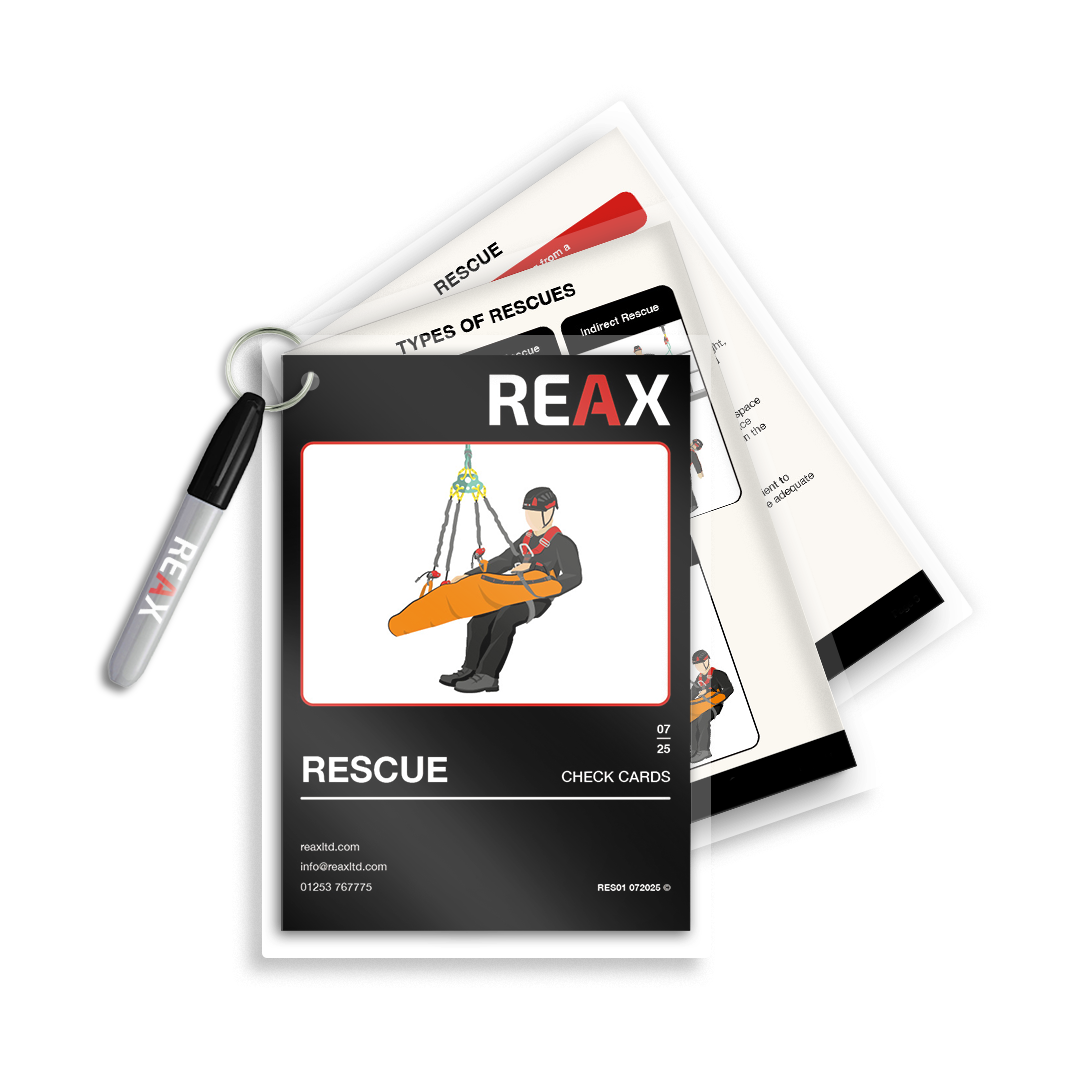
While video content supports learning and development, rescue planning must also be accessible on site at the point of work.
To support this, we’ve introduced the REAX Rescue Check Cards.
These cards are printed and encapsulated in a hard laminate for increased durability. Each pack includes a wipeable pen attached to the cards, allowing teams to make notes during planning and erase them for repeated use.
Designed specifically for use in rope access, work at height, and confined space environments, these cards support structured rescue planning and execution before tasks begin.
Contents include:
- Rescue planning considerations
- Initial scene assessment
- Casualty condition awareness
- Equipment selection and configuration
- Descent control principles
- Anchor and system checks
- Communication and team roles
- Post-rescue considerations
This allows supervisors and operatives to brief teams using consistent language and structured decision-making prompts, reducing the likelihood of critical rescue planning steps being overlooked.
Why Structured Rescue Planning Matters
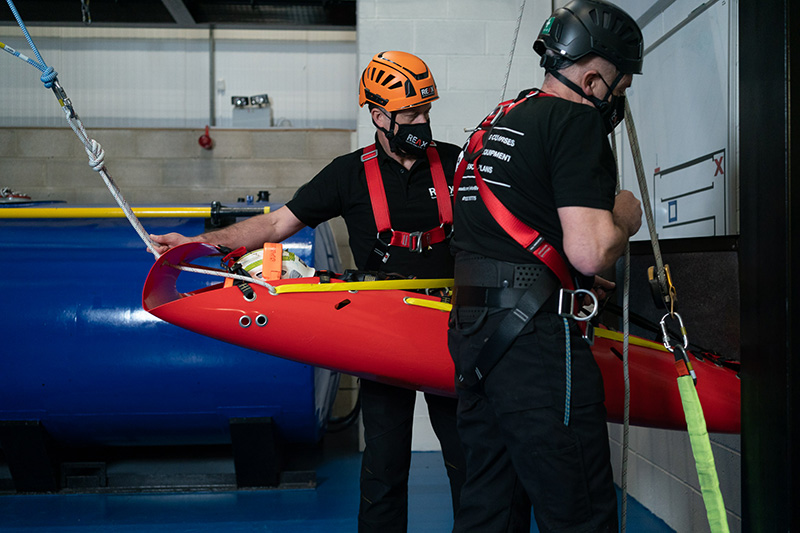
Emergency rescue situations are time-critical.
Suspension intolerance, environmental hazards, and casualty condition can all deteriorate rapidly if recovery is delayed. Without a clearly defined rescue plan, teams may hesitate, improvise, or attempt recovery using inappropriate systems.
A structured rescue checklist helps ensure:
- Equipment compatibility has been considered
- Anchors are suitable for expected loads
- Communication protocols are understood
- Rescue roles are assigned
- Mechanical advantage systems are available if required
- Casualty management procedures are planned
Importantly, it also helps protect rescuers by reducing exposure to unnecessary risk during recovery operations.
Building a Practical Rescue Plan
Effective rescue planning is not about creating paperwork.
It’s about ensuring teams can:
- Recognise when rescue is required
- Implement a suitable rescue method
- Recover casualties efficiently
- Maintain control throughout the process
- Handover safely following recovery
Using both digital learning tools and physical on-site rescue checklists provides a layered approach to emergency readiness.
Videos support knowledge development.
Check cards support practical implementation.
Rescue Planning Support
Rescue planning can be complex, particularly in specialist environments involving confined spaces or work at height.
If your organisation requires support developing rescue procedures or validating an existing rescue plan, REAX can assist with consultancy, training and implementation.
Summary
Emergency rescue planning should be a structured, proactive process, not a reactive afterthought.
Using:
- A defined rescue plan
- A practical rescue checklist
- Structured video guidance
- On-site briefing tools
Helps ensure teams are prepared to respond effectively should an incident occur.
Rescue is not optional.
Planning for it shouldn’t be either.


Looking after your kit
Even the best kit needs regular inspection and servicing. we have a team of fully trained PPE inspectors who can take the worry out of the process. Our servicing team are fully certified to carry out the servicing requirements for many of the leading rescue devices currently on the market.



Unit 4 Keystone Court, Hallam Way,
Whitehills Business Park,
Blackpool,
FY4 5NZ
Company Number: 09204984
VAT No: 199729531
01253767775 Opt 1
info@reaxltd.com
Unit 1 & 2 Keystone Court, Hallam Way,
Whitehills Business Park,
Blackpool,
FY4 5NZ
Company Number: 11576372
VAT No: 307530624
01253767775 Opt 2
equipment@reaxltd.com